
A divorce involves a lot of things that need to be arranged. The ex-partners have to make financial agreements with each other, for example. These agreements are set out in the divorce settlement agreement (echtscheidingsconvenant), sometimes also called a separation agreement (scheidingsconvenant). The agreements included in the divorce settlement agreement are later confirmed by the court. This page describes the situation in the Netherlands.
Agreements in the divorce settlement agreement
A divorce often has a huge impact and is emotionally draining. That is why, in most cases, people call on a mediator or a lawyer. They help to make suitable agreements. These agreements are then included in the divorce settlement agreement. Certain matters must not be missing from the divorce settlement agreement.
1. Maintenance
After the marriage has ended, it may be necessary to award spousal maintenance (partneralimentatie). The ex-partner who is in the better financial position then pays maintenance to the ex-partner who is financially weaker. There are statutory rules on this, but the ex-partners are also free to make their own agreements about it. These agreements are then included in the divorce settlement agreement.
All about spousal and child maintenance2. Rented or owner-occupied home
You used to live together and now you are going to live apart. If you live in a rented home, one of the partners may want to take over the tenancy agreement. It is possible to agree on this. The landlord may have to amend the contract, for example if the partner who stays is not the main tenant. If there is a dispute about who may stay in the rented home, the court decides. Among other things, the court takes various factors into account, such as:
- Who has lived in the home the longest
- Whether that person can pay the rent
- Who the children live with
- Who works near the home
- And so on
With an owner-occupied home, things are different. Then it matters, among other things, who owns the house, whether there is a prenuptial agreement (huwelijkse voorwaarden) and what that agreement says. However, agreements can also be made about an owner-occupied home.
Divorce and legal expenses insurance3. Division of possessions and assets
In a divorce, the joint possessions have to be divided. Among other things, it matters whether you married in community of property, in limited community of property or with a prenuptial agreement. This determines how the possessions are divided. This can also include the household contents and the debts. Either way, agreements about this can be made in the divorce settlement agreement. For example, you can decide who gets the car and who gets the sofa. And how each of you will pay part of the debts.
4. Pension
In principle, each of you is entitled to half of the other's old-age pension. The person with the higher old-age pension will therefore have to give up a part of it. However, it is possible to arrange this differently. For example, you can decide to apply a different division or not to divide the pension at all. Such alternative agreements are included in the divorce settlement agreement. Do not forget to notify the pension administrator. You can do this using the notification form (pdf) provided by the Ministry of Social Affairs and Employment.
5. Divorce settlement agreement and your own business
The end of a marriage can also have consequences for the business. The way in which you were married then plays an important role. With community of property, the business also belongs to the community, which means it has to be split. Or one ex-partner has to buy out the other ex-partner. A prenuptial agreement may of course provide otherwise. Sometimes provisions in the prenuptial agreement, such as the periodic settlement clause, cause problems. Fortunately, it is possible to make agreements in the divorce settlement agreement that focus on the continuity of the business. After all, neither ex-partner benefits from the end of the business, quite the opposite.
Parenting plan
When you separate and there are children under the age of 18, it is mandatory to draw up a parenting plan (ouderschapsplan). The parenting plan contains agreements on caring for and raising the children. The parenting plan will always contain agreements on:
- The division of upbringing and care (care arrangement)
- Contact with the children (contact arrangement)
- Keeping each other informed about the child (see also the right of parents to information from the school)
- Deciding on important matters, for example the choice of school
- Dividing the costs of care and upbringing (child maintenance)
- Involving the children
In addition, parents are free to include extra agreements in the parenting plan. For example, agreements can be made about contact with certain family members or about sports activities. In any case, it is important to involve the children. This is a legal requirement. If you cannot manage to draw up a parenting plan together, you can call in the help of a mediator.
Divorce settlement agreement checklist
Drawing up a divorce settlement agreement is always tailor-made. What does or does not need to be in a divorce settlement agreement differs from case to case and also depends on the agreements you make. This checklist offers something to hold on to and contains the most important points that must not be missing from the divorce settlement agreement. You can of course also include other decisions and agreements in the divorce settlement agreement.
Spousal maintenance
Will spousal maintenance apply or not?
If yes:
- The amount of spousal maintenance and how it is calculated
- How and when the spousal maintenance must be paid
- Start date of the spousal maintenance
- End date of the spousal maintenance
If no:
- Are you waiving spousal maintenance permanently, or are you making a reservation for changing circumstances?
Rented home
Will one of you stay in the home?
If yes:
- Who will stay in the rented home?
- When must the ex-partner leave the home?
- When must the landlord be informed, and by whom?
- In whose name is the tenancy agreement?
If no:
- When will the landlord be informed, and by whom?
- When must the home be vacated?
Owner-occupied home
Address of the owner-occupied home
Will you sell?
If yes:
- Agreements on dividing the residual debt or the surplus value of the home
Will one of you take over the joint home?
If yes:
- Agreements on the buyout
- When will you go to the civil-law notary (notaris) and the mortgage lender to arrange the transfer of the home?
Price estimate or valuation of the home
Amount of the mortgage
(Temporary) arrangement on who stays in the house
(Temporary) arrangement on paying the owner's costs and running costs
Possessions, assets and debts
- Inventory of the household contents
- Balances of the bank and savings accounts and the account numbers
- List of investments and annuities and their value
- Information about endowment insurance policies
- List of all debts
- Total assets and division key
- Total debts and division key
- Division of household contents, vehicles and special possessions (e.g. heirlooms)
- Division of pets and possibly a contact arrangement
- Practical agreements on arranging transfers of ownership
Pension
- Amount of the old-age pension
- Pension numbers of both partners
- Is there a special partner's pension or survivor's pension?
- Choice: equalisation, conversion or no division?
Own business
- Name of the business and type of business
- Value of the business
- Choice: stop, buy out or divide, plus practical agreements
- Has there been a relatively constant salary over the past few years?
Who can draw up the divorce settlement agreement?
The principle is that the divorce settlement agreement is drawn up by the ex-partners, who make agreements together. In practice, drawing up a divorce settlement agreement is complex and people often need help from a third party. That is why a mediator, for example, can also draw up the divorce settlement agreement.
Drawing up the divorce settlement agreement with your ex-partner
If it is possible to talk things through together and reach fair compromises, you can draw up the divorce settlement agreement together. If needed, you can call in the help of a mutual friend or acquaintance. Advisers can also help to clarify certain matters.

Drawing up the divorce settlement agreement through a mediator
In a divorce, emotions can sometimes run high, and then it is difficult to draw up a divorce settlement agreement together. In many cases it is useful to call on a mediator. A mediator is an independent person who helps with the conversation. The mediator can also turn the agreements made into a divorce settlement agreement.

Drawing up the divorce settlement agreement with a civil-law notary
Like a mediator, a civil-law notary can help with holding the conversations and making the agreements. The agreements that are eventually made are then included in the divorce settlement agreement. Usually both ex-partners first receive a draft, so that they can read it in peace. That draft can still be amended if necessary. If you both agree with the arrangements, you sign it in the presence of the civil-law notary. The agreements are then immediately enforceable.

Drawing up the divorce settlement agreement with a lawyer
You can have the divorce settlement agreement drawn up by one lawyer, or by the two lawyers of both ex-partners together. The lawyer will include the agreements made in the divorce settlement agreement and then send it to the court, so that the judge can make the agreements final. If you have a low income, you may be eligible for subsidised legal aid (gesubsidieerde rechtsbijstand).

| Who draws it up? | What does this party do? |
|---|---|
| The ex-partners themselves | Talk things through together and reach compromises, possibly with help from a mutual friend or adviser |
| Mediator | An independent person who helps with the conversation and can turn the agreements into a divorce settlement agreement |
| Civil-law notary | Helps with the conversations and prepares a draft; signing in the presence of the civil-law notary makes the agreements immediately enforceable |
| Lawyer | Includes the agreements in the divorce settlement agreement and sends it to the court, so that the judge makes the agreements final |
How drawing up and submitting a divorce settlement agreement works
A divorce settlement agreement, or divorce agreement, is a very important document. It contains all the agreements relating to the divorce. That is why a divorce settlement agreement must be drawn up very carefully. In many cases people call on an expert, such as a mediator or a lawyer.
- Drawing up the divorce settlement agreement
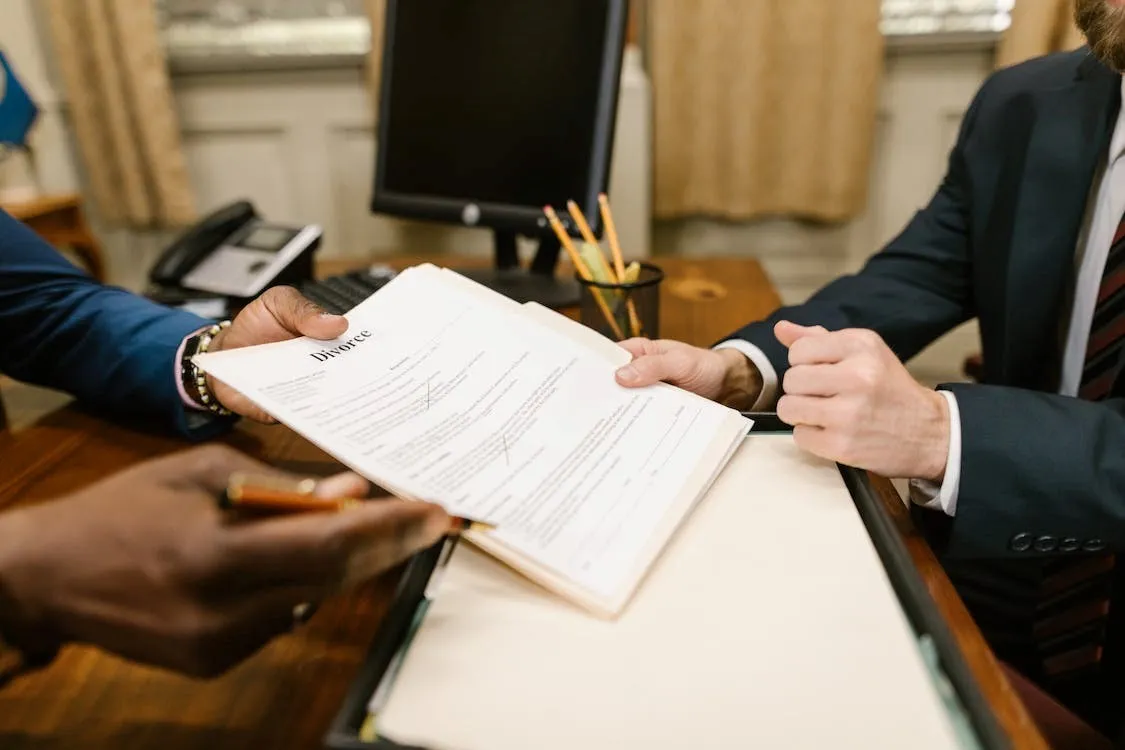
In principle, the ex-partners can draw up a divorce settlement agreement together, but it is also possible to have a civil-law notary, a lawyer or a mediator do this. In any case, joint agreements are central. The divorce settlement agreement includes, among other things, agreements on maintenance, the owner-occupied home, possessions, debts and the pension. Once everyone agrees with the divorce settlement agreement, it is signed.
- Making agreements about the children

If there are children under the age of eighteen, it is mandatory to draw up a parenting plan as well. The children must also be heard. The parenting plan includes agreements on the contact arrangement, child maintenance, residence arrangement and so on.
- Sending the divorce settlement agreement to the court

Once the divorce settlement agreement has been drawn up, it is sent to the court together with the parenting plan. The judge is then asked to confirm the content of the divorce settlement agreement. If the judge does so, the agreements are final. If the ex-partner then does not pay, a bailiff can be called in.
A divorce settlement agreement is not mandatory
It is not always mandatory to draw up a divorce settlement agreement. If children are involved, however, a parenting plan must always be drawn up. If no divorce settlement agreement is drawn up, a one-sided petition can be filed, for example. The judge will then have to make various decisions. If the ex-partners still get on well with each other, they can also decide not to draw up a divorce settlement agreement and to put a few agreements on paper themselves. In practice, however, drawing up a divorce settlement agreement is strongly recommended.
Example: why a divorce settlement agreement is useful
A divorce settlement agreement is the best guarantee that the agreements made will be carried out, if necessary after calling in a bailiff. This is because the agreements made are enforceable. Suppose, for example, that Robin and Marie are getting divorced and have a divorce settlement agreement drawn up, stating that Robin must pay Marie €500 in spousal maintenance every month. The court confirms the divorce settlement agreement.
For a while everything goes well, but later it turns out that during the marriage Marie slept with Robin's best friend. Robin now suddenly refuses to pay the spousal maintenance. However, because there is a confirmed divorce settlement agreement, Marie can immediately call in a bailiff to collect the maintenance. If there had been no confirmed divorce settlement agreement, she would first have had to go to court and then wait for a long and expensive legal procedure. And that for every conflict that arises in the future!
Reopening the divorce settlement agreement
One of the features of a divorce settlement agreement is that the agreements are, in principle, recorded irrevocably. That is precisely the main advantage of drawing up a divorce settlement agreement: certainty. As a result, a divorce settlement agreement cannot, in principle, be changed unilaterally. A divorce settlement agreement can only be changed in three cases:
- The divorce settlement agreement contains an amendment clause and the conditions for amendment have been met.
- Both partners agree on the change and make a supplementary agreement that amends the original divorce settlement agreement.
- There are unforeseen circumstances and the judge rules that, as a result, the agreements made are no longer reasonable.
Incidentally, on some points the agreements change automatically. This is the case, for example, for maintenance amounts, which by law must be indexed every year. As a result, the amounts differ from those in the divorce settlement agreement. Things also change if, for example, the ex-partner remarries: the ex-partner then loses the right to maintenance. No supplementary agreement is needed for this, as it follows from the law.
Sample divorce settlement agreement
A divorce settlement agreement is always personal. This means a template cannot be used. When drawing up a divorce settlement agreement, it can still be useful to look at a sample divorce settlement agreement. Reasonable agreements from a sample document can sometimes help to shape or properly word your own agreements.
Download a sample divorce settlement agreement (pdf, 2022)
Read also: Complaint about a civil-law notary and complaint about a lawyer.
Frequently asked questions about the divorce settlement agreement
When you and your partner separate, you have a lot to deal with. Not only a lot of emotions, but also many practical things that need to be arranged. Of course you want to settle things once and for all, and that is exactly why you need a good divorce settlement agreement. If you still have questions about it, we recommend reading the FAQ about the divorce settlement agreement below.
Who draws up the divorce settlement agreement?
The divorce settlement agreement is drawn up by the ex-partners together. They can also be guided in this, for example by a mediator, a lawyer or a civil-law notary. The mediator, lawyer or civil-law notary can then draw up the divorce settlement agreement.
Why should I draw up a divorce settlement agreement?
A divorce settlement agreement provides certainty and transparency. Making agreements now prevents arguments and misunderstandings. In addition, the agreements made are binding and enforceable, which means it is not necessary to go back to court for every legal conflict. For example, a bailiff can be called in straight away if the ex-partner does not pay the maintenance.
Is a divorce settlement agreement binding?
Yes, a divorce settlement agreement that has been confirmed by the court is binding. In principle, therefore, it can only be departed from if both ex-partners agree to this. Only when circumstances have changed can it sometimes be departed from, if the agreements made are no longer reasonable as a result. It is the judge who rules on this.
What happens after the divorce settlement agreement has been signed?
After the divorce settlement agreement has been signed, the lawyer will send it to the court. Once the lawyer has received the date of receipt, he passes it on. From this moment, it is possible to apply for various allowances (toeslagen), such as the rent allowance (huurtoeslag) and the healthcare allowance (zorgtoeslag). It is also possible to sit down with the mortgage lender. After the judge's decision, the deed of acquiescence (akte van berusting) is signed, and finally the request to register the divorce with the municipality follows. And then only one thing remains for you: complying with the agreements made.
Can I request a copy of the divorce settlement agreement?
Yes, it is possible to request a copy of the divorce decree (echtscheidingsbeschikking). You do this at the court where the divorce was granted. For decisions dating from before 1990, the copy can be requested from an archive. How to request a copy differs per court. If you used a lawyer to draw up a divorce settlement agreement, you can always request it from that lawyer as well.
What can I do if my ex-partner does not comply with the divorce settlement agreement?
If the ex-partner does not comply with the agreements made, you can hold the ex-partner to account and demand that he or she complies with the agreements. To do this, the ex-partner is formally given notice of default. If the ex-partner does not respond to this, compliance can be enforced through the court. If the ex-partner does not pay the maintenance, a bailiff can be called in.
What is the difference between a parenting plan and the divorce settlement agreement?
A divorce settlement agreement contains all the agreements relating to the divorce and is, in principle, not mandatory. A parenting plan only contains the agreements about minor children. If there are minor children, drawing up such a parenting plan is mandatory.