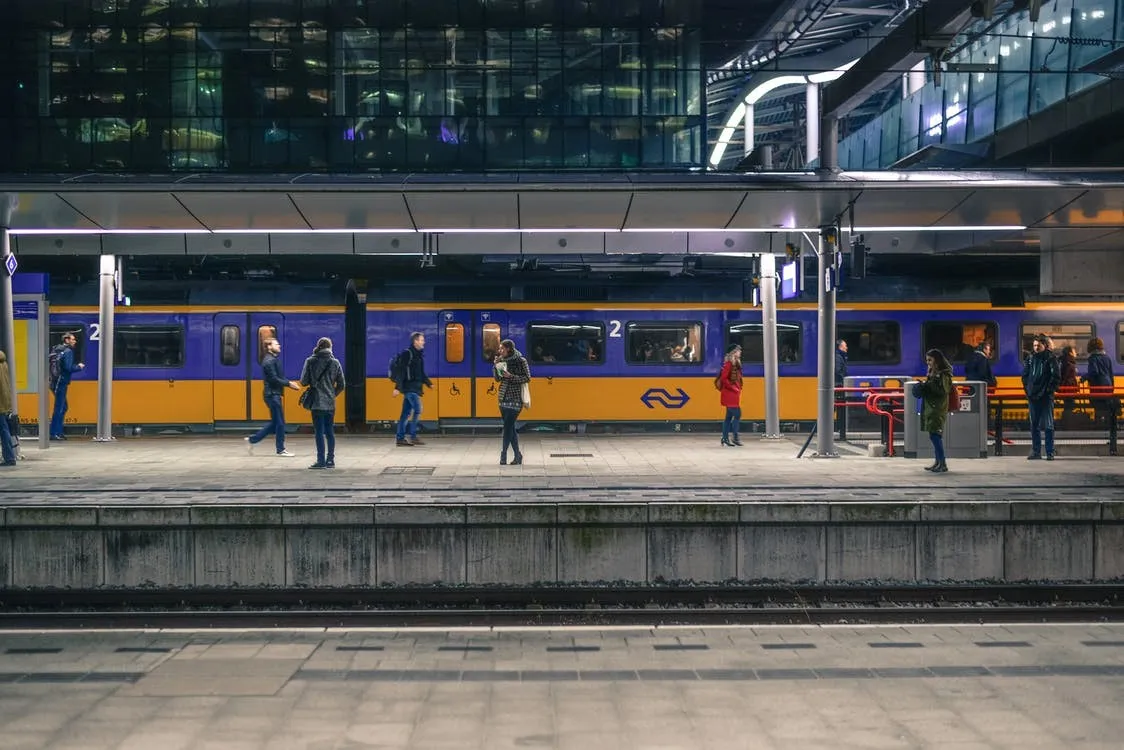
Explained: damage from an accident involving a train
Train accidents can happen for all kinds of reasons. A train passenger who trips over luggage, a train that hits a person walking on the track, or two trains that collide, to name but a few. These are often cases of damage in which someone is at fault, and in which the question of liability is therefore raised. For the train passenger and for third parties, it is not always clear who bears liability. This page describes the situation in the Netherlands.
Train passengers with personal injury
First of all, train passengers can suffer personal injury. Here, the Dutch Railways (NS) bears an important responsibility. NS has entered into a contractual relationship with the passenger and is obliged to transport the train traveller from one location to another. It goes without saying that this must also happen without damage.
To protect the train passenger, article 8:105 of the Dutch Civil Code (Burgerlijk Wetboek, BW) was introduced. This statutory provision sets out the following:
- The rail carrier is liable for the death or injury of passengers resulting from an accident that happened in connection with and during the transport.
- The rail carrier is not liable if the accident was caused by a circumstance that a careful carrier could not have avoided and whose consequences a careful carrier could not have prevented.
- The rule is that a careful carrier could have avoided physical or mental shortcomings of the driver, the train functioning poorly or the equipment functioning poorly. Equipment also includes the railway infrastructure.
- A mistake by a third party is only taken into account when no mistake at all can be attributed to the rail carrier.
In practice, the liability of NS goes a long way. NS can try to invoke force majeure, but as indicated above, that has little chance of success.
Providing proof as a passenger
NS does not keep passenger lists. A dispute therefore often concerns the question of whether a passenger was on the train at all. It is up to the train passenger to provide proof of this. That proof can be provided with an overview of the travel history of the OV-chipkaart (public transport smart card), or of the bank card used to check in and out (OVpay).
Own fault possible
In addition, it is of course always possible that a passenger is at fault themselves. Think, for example, of a drunk passenger who falls flat on their face when the train brakes abruptly. Perhaps the driver did make a mistake and their employer, NS, is liable after all. But there may well also be contributory fault. That presumption certainly exists when the passenger is the only passenger who suffered damage.
Compensation after a train accident
The liability of the rail carrier is limited by law. As a result, in the event of death or injury NS is only liable up to 175,000 units of account per passenger (article 8:110 BW and article 1 of the Decree under article 110 of Book 8 BW). A unit of account is a Special Drawing Right (SDR) of the International Monetary Fund, which means that the exact maximum limit in euros can differ from day to day.
However, the maximum limit no longer applies when there has been recklessness on the part of NS. Victims are then entitled to full compensation after all. This compensation must cover all actual costs. These include, for example:
- Material damage (e.g. damage to luggage or glasses)
- Medical costs that are not covered by the health insurance (excess, eigen risico)
- Loss of income
- Compensation for pain and suffering (smartengeld)
- Costs of domestic help
- A gym membership that can no longer be used
- A trip that can no longer go ahead
- Loss of a year of study
- And so on
In any case, personal injury in a train accident can run high. Passengers do not wear seat belts, the high speed can leave a train completely mangled, and in a collision the consequences are even such that death may well follow. The maximum amount mentioned above can therefore be called rather limited.
Train accidents with other causes
Other train accidents are of course less common. These include, for example, an accident in which a car is hit by a train.
In that case, the classic rules on causation play a role. If the car driver made a mistake, the third-party liability insurance (WA) will cover the damage. You do have to be careful with other insurance policies, such as casco insurance. These sometimes contain exclusions for collisions with a train. The Motor Insurers' Guarantee Fund (Waarborgfonds Motorverkeer) does not offer a way out either, by the way, because it only pays compensation in the case of unknown or uninsured motor vehicles. Here, the train is not unknown, not uninsured and, moreover, is not even regarded as a motor vehicle. This happened in 2017, for example, to a student whose car broke down right on a level crossing.
In some cases, it is possible that neither the keeper of the vehicle nor NS is liable, but the municipality is. That is, for example, one of the issues raised in an accident between a lorry and a train. Lorries there are said to get into trouble more often because of the uneven road surface and the difficult bend. In the end, it came to a collision. The municipality had already received complaints about this before and never intervened. So here the liability of the road authority comes into play. In this case, it is not clear whether the train driver made a mistake. According to some bystanders, he should have been able to stop much earlier. If that is the case, NS will also have to pay for the damage of the two occupants who were injured.
Finally, we can also refer to the train accident in Dalfsen (ECLI:NL:RBOVE:2017:3622). There, an employee drove a telescopic aerial work platform over a level crossing. Such a telescopic aerial work platform reaches a top speed of around 1 km per hour. As a result, the telescopic aerial work platform needs 76 seconds to cross the level crossing, while the cycle of the automatic half-barrier crossing (AHOB) only lasts 32 seconds (a cycle with an initial warning, the barriers lowering and the wait until the train has passed, until the barriers open again). In other words, the employee should have checked the train timetable, but had not done so. In the end, it came to a fatal collision.
The train derailed, the driver died and a passenger and the conductor were injured. The employee himself survived the accident by jumping out of the aerial work platform in time. The liability of the employee is established here. The employer also made a mistake by simply letting an employee start such a dangerous crossing. Finally, it can be pointed out that ProRail, the manager of the Dutch railway network, did not provide any instructions, procedures or information for such slow-crossing transport.
Frequently asked questions about liability in train accidents
Who is entitled to the Individual Payment for Victims of WWII NS Transports (Individuele Tegemoetkoming Slachtoffers WOII Transporten NS)?
This concerns all persons from the Jewish communities or from the Sinti or Roma communities who, on the orders of the German occupiers during WWII, were transported in trains adapted by NS to concentration and extermination camps, or to Westerbork, Vught or Amersfoort in order to be taken from there by the occupier to the concentration or extermination camps. Other victims, such as deported resistance fighters, are not eligible for compensation. All applications submitted before 5 August 2020 will be processed. The committee is currently no longer accepting new applications. Processing the applications will take a maximum of 13 weeks, but if the committee needs extra time, this will be communicated. In particular, the committee checks whether the person concerned was indeed transported by NS to one of the locations mentioned or to the concentration and extermination camps.
How much is the compensation under the Individual Payment for Victims of WWII NS Transports?
Victims who were transported by NS during WWII are entitled to a fixed-sum compensation. The amount of this compensation depends on the category into which the victim or the victim's heirs fall. Victims may be entitled to compensation in more than one category. [1] Was still alive on 27 November 2018: €15,000 [2] The widow or widower of the transported person who was no longer alive on 27 November 2018: €15,000 [3] Children of the victim, if the widow or widower and the transported person were no longer alive on 27 November 2018. The eldest child must have been born on 8 May 1945 at the latest: €7,500 [4] Same situation as in point 3, but the eldest child was born after 8 May 1945: €5,000
Can I get compensation from NS for a delay?
Yes, that is possible even when there is no case of damage. In that second case, however, the contractual agreements made with NS apply. A number of restrictions apply here. For example, no compensation is paid when it is lower than €2.30 or when there was a special case of force majeure (source: ns.nl, November 2026). The compensation granted depends on the type of ticket or subscription, the type of train and the length of the delay. In principle, at most the ticket (or a proportional part of the subscription) is refunded. Consequential damage is contractually excluded. In serious accidents, other consequential damage is also eligible for compensation. The limitation of liability is then "broken through". Think, for example, of compensation for missing a flight. In the past, there were also situations in which NS reached a settlement without there having been an accident. These were, however, extreme situations in which a train was often stuck for hours because of a defect.
How much time do I have to hold NS liable?
A legal claim against the carrier for injury becomes time-barred three years after the day of the accident (article 8:1751 BW). So do not wait too long to hold NS liable, and take action quickly.
Are the maximum compensation amounts often broken through?
No. The chance of breaking through these compensation limits is very limited, and it really has to be a gross breach. It did happen in 2002, for example (ECLI:NL:RBUTR:2002:AF2338). A passenger wanted to board a sprinter train. The passenger heard the conductor's whistle and ran to the stationary train, whose doors were closing. Her hand got trapped between the doors. Investigation later showed that the technical safety system on board these sprinter trains was not sufficient to detect in all circumstances that a hand was trapped between the doors. The conductor did notice something and ran towards the passenger. At that moment he wanted to inform the driver so that the doors would be opened manually, but the battery of the driver's combiphone (combifoon) was flat. The driver knew this, and there was no guideline at all requiring the battery to be replaced. The conductor then decided, still on the platform, to run to the driver. He did not want to leave his key unattended and took the key with him. In doing so, he made a human error: when the key is removed, the driver receives the signal to depart. Later investigation showed that the NS departure procedure was not psychologically sound and encouraged such errors. The train departed, the conductor could no longer follow and therefore could not pull the emergency brake either. As a result, three safety systems (the technical signal, the visual check with communication via the combiphone, and the operation of the emergency brake by the conductor) failed. The passenger was dragged along and lost both her legs. Finally, investigation showed that the doors had not been adjusted correctly in the workshop and that the workshop did not even have the equipment to carry out the necessary safety checks. In this situation, so many gross errors were made that the judge considered it appropriate to break through the maximum compensation. Fortunately, such situations do not occur often in practice.
Insurance related to liability
- Liability and insurance
- Business liability
- Professional liability
- Car insurance
- Classic car insurance
- Youngtimer insurance
- Casco insurance
- All-risk insurance
- Home contents insurance
- Motorcycle insurance
- Accident insurance
- Buildings insurance
- Legal expenses insurance
- Travel insurance
- Third-party liability insurance (WA)
- Home insurance
Liability of persons
As a general rule, there are two possibilities:
Want to hold someone liable? Download the sample letter:
About this page
Written by Ronald de Waard, insurance editor. Last updated on 9 November 2026. WA.nl provides general information, not personal advice.