In principle, you are responsible for your own actions. However, sometimes you can also be responsible for the actions of others. This is the case, for example, for parents who are liable for their children or employers who are liable for mistakes made by their employees. Another exceptional situation is group liability. This means that members of a group can be liable for the conduct of that group, even if the individual member did not commit the unlawful conduct themselves. This page describes the situation in the Netherlands.
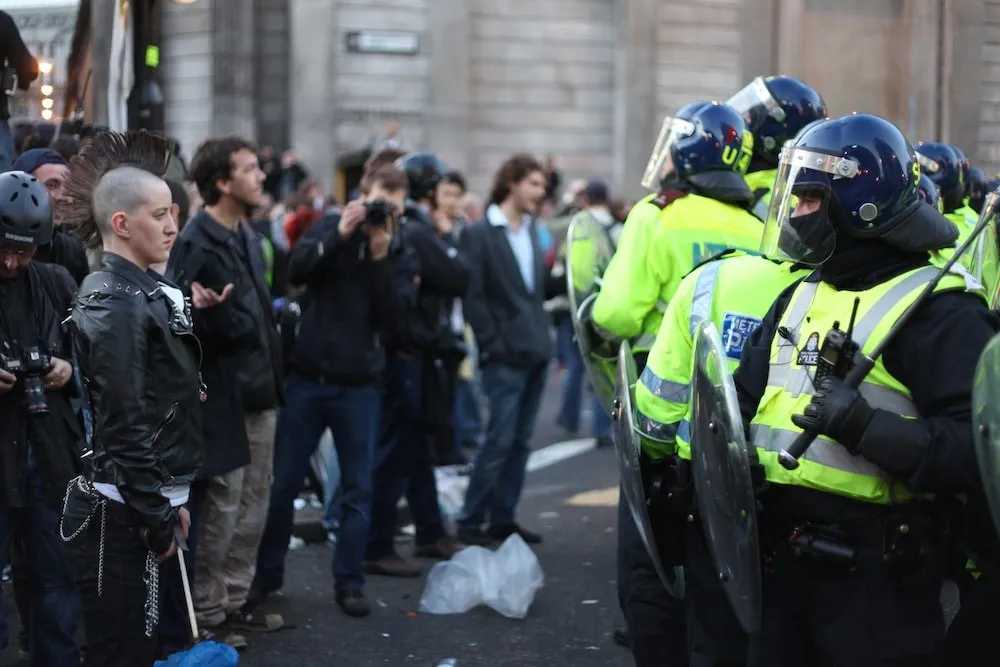
What is group liability?
Group liability is a legal concept under which each member of a group can be held liable for the full damage caused by the group as a whole. This means that when one or more individuals within a group perform an act that causes damage, each member of that group can be held liable for the entire damage. And this regardless of their individual contribution to the actions that caused the damage. This concept is often applied in situations where it is difficult to determine the exact actions of individual group members. It is then enough to identify one or more members and to claim all the damage from those group members.
Characteristics of group liability
Group liability can arise, among other things, when football hooligans riot or when there is street terror. However, group liability does not apply just like that; a number of conditions are attached to it. For example, the conduct must also be attributable to the members of the group. This follows from Article 6:166 of the Dutch Civil Code (Burgerlijk Wetboek, BW).
The group must act unlawfully
A group member can only be liable if he or she is part of a group that acts unlawfully. This is something different from a single member of the group acting unlawfully. What is not required is a causal link between the unlawful conduct of the group member and the damage. In other words, «If I hadn't been there, the damage would have happened anyway» is a poor excuse. It does not release a group member from liability. Nor does the group need to have any particular form of organisation.
Joint and several liability
If there is group liability and the requirements of Article 6:166 BW are met, each member of the group is jointly and severally liable for the damage. Joint and several liability means that anyone can be required to compensate all the damage, every single euro. Afterwards, you can reclaim the amounts paid from the other group members, if they are able to pay. Otherwise, you remain responsible for these debts of others. Joint and several liability prevents group members from concealing the identity of other members, which would leave victims with no compensation or only partial compensation. For a victim, it is enough to identify one or more of the perpetrators.
Unlawful act
There is an extra requirement attached to the above: the group member who is held liable must have committed an unlawful act themselves. However, this does not have to be the unlawful act that caused the damage to the victim. It is enough that the person was unlawfully part of a group that causes damage, while this alone should have stopped the group member from being part of the group. The group member must be to blame for the group's conduct.
So he or she must know, or should have understood, that the group's conduct carried a risk of damage. And yet he or she must have remained part of the group. So if someone takes part in a peaceful demonstration and suddenly someone starts throwing stones, a group member will not automatically be liable for the unlawful conduct of that individual. The risk of escalation in a peaceful group is not great enough, and the escalation was not within the bounds of what could be expected.
It is not always the case that you are automatically liable just because you were there. Sometimes it is simply not possible to leave the scene of the events, for example if you are in a closed train compartment. The court will have to assess this on a case-by-case basis.
Unity of time and place is not a requirement
Group liability often comes into play in riots and disturbances, for example when a hard core of one team's supporters attacks the supporters of another team. We then speak of conduct in turba. Yet group liability can also arise in other situations. In an earlier case (ECLI:NL:HR:2015:2914), for example, cargo thefts from lorries took place. These thefts happened at different times and locations, but according to the Dutch Supreme Court (Hoge Raad) this was no obstacle to group liability. According to the Supreme Court, unity of time and place is therefore not required. People who contribute to or lead the group's conduct behind the scenes, and who are therefore not present at the time of the events, can also be held liable, for example the leaders of a motorcycle club.
Step-by-step plan to avoid group liability
In an ideal world, all gatherings, demonstrations and group activities would be peaceful, without escalation, violence or destructive behaviour. Unfortunately, things sometimes turn out differently. It is important to understand that, as a participant in such a group, you can potentially be held responsible for the group's actions, even if you did not personally take part in the violence. This step-by-step plan is intended to help you deal with situations in which a group you are part of behaves violently. These steps can help you limit your liability and, where possible, avoid it.
- Awareness
Make sure you are always aware of the situation and that you understand clearly what is happening. This helps you respond in time and take the necessary measures.
- Keep your distance
If you notice that a group you are part of is starting to become violent, try to distance yourself from that group as quickly as possible.
- Self-control
Don't get carried away by the group. Stay in control of your own behaviour and try to keep the peace.
- Avoid taking part in violent acts
If the group becomes violent, try to refrain from taking part in violent acts. Try to distance yourself from the group and leave the scene.
- Seek help
Contact the police or other authorities as soon as possible if you notice that the situation is getting out of hand.
- Keep records
If it is safe to do so, document as much of the events as possible with photos, videos or written notes. This can later serve as evidence that you did not take part in the group violence.
- Legal advice
Seek legal advice if there is a chance that you will be held liable for the actions of the group.
Reclaiming compensation paid from other group members
If you have been held jointly and severally liable for the damage caused by a group, this means that you have to compensate the full damage. Even if other members of the group are also liable. Fortunately, there is a legal mechanism that allows you to recover part of these costs from the other liable group members. This process is called "recourse" (verhaal halen).
In practice, this means that after you have paid the compensation, you can bring a separate lawsuit against the other members of the group to get back their share of the compensation. It is important to realise that the chances of success of such claims depend heavily on the specific circumstances. You will also have to be able to prove that the people involved were part of the group and are liable.
This can be a lengthy and potentially costly process, so it is advisable to get legal advice before taking such a step. It is also important to realise that you can only get the money back from group members who are actually able to pay.
Insurance and damage during riots or demonstrations
Riots and demonstrations can cause considerable damage to personal property. Shop windows are smashed, cars are set on fire and scooters are destroyed. Unfortunately, insurance does not always offer a solution.
Third-party liability insurance (WA), for example, only covers damage that you cause to others, so damage to your own car or scooter is not covered. Limited casco insurance (WA+) does cover fire damage, but vandalism by rioters is sometimes excluded. Fully comprehensive (all-risk) insurance usually does cover damage caused by vandalism. However, some insurers make exceptions for so-called 'civil commotion' (binnenlandse onlusten). To claim for damage, you must first report it to the police, even if the perpetrator is unknown.
If your home or garden is damaged, it is also advisable to report it to the police first. Cover for this damage depends on your home contents and buildings insurance. For example, window damage is often only covered if you have added glass cover to your buildings insurance. Damage to loose items, such as garden furniture, is sometimes covered by your home contents insurance.
Frequently asked questions about group liability
The idea that someone can be liable for something he or she did not do personally often feels unfair. Yet we should be aware of the impact we all have on the behaviour of a group. And we should realise that taking part in a group event also brings a certain responsibility. If, like many other people, you still have some questions about this, it is a good idea to read through this FAQ on group liability carefully.
What does it mean to be jointly and severally liable?
Joint and several liability means that each individual within a group can be held fully responsible for the entire damage. This means that the victim can hold any group member liable for the full damage.
Does group liability apply to minors under the age of 14?
No, group liability does not apply to children under the age of 14. In this case, only the parents (or guardians) can be held liable for the damage that their child actually caused. So it has to be shown what the child did themselves; the parents are not simply liable for the behaviour of the whole group.
Can I be held liable for damage if I did not commit any violent acts myself during a gathering or demonstration?
Yes, it is possible that you will be held liable for the damage caused by the group as a whole, even if you did not commit any violent acts yourself.
How can I protect myself against group liability?
The best way to protect yourself against group liability is to be aware of the situation, to distance yourself from the group when it becomes violent and to contact the authorities when the situation gets out of hand.
What does it mean when an insurance policy excludes civil commotion?
When an insurance policy excludes civil commotion, this means that the policy does not cover damage caused during riots or demonstrations. The victim will have to submit a claim themselves to the liable party or to the members of the group.
Can an individual be liable for the actions of a group if they are not at the same location?
Yes, group liability does not depend on time and place. This means that individuals who contribute to or lead the actions of a group from a distance can also be held liable. Even if they were not there at the time of the events.