When lorries overtake, especially when a lorry overtakes another lorry, bottlenecks arise in terms of traffic flow. This is because lorries do not accelerate quickly and therefore overtake at a slow pace. Bottlenecks like these affect road safety. That is why an overtaking ban for lorries applies on part of the motorway network in our country. This page describes the situation in the Netherlands.
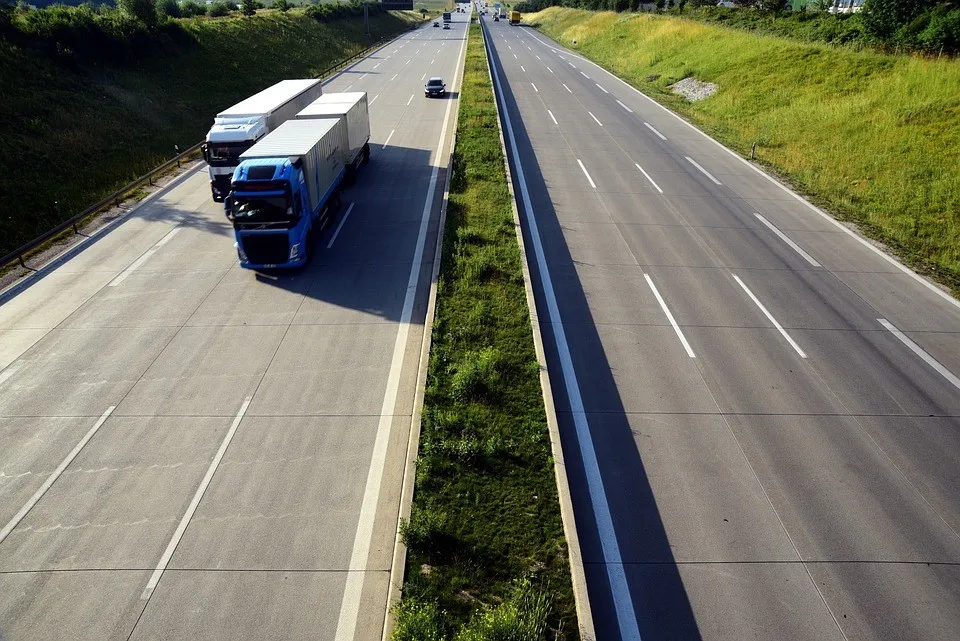
Overtaking ban for lorries (IVV)
The overtaking ban for lorries (inhaalverbod voor vrachtwagens, IVV) prohibits lorries from overtaking on designated sections of the motorway at certain times of the day or throughout the day. This ban applies on motorways with 2 x 2 lanes. An overtaking ban for lorries does not apply on all motorways. The ban is only introduced if it is necessary for good traffic flow and road safety. The overtaking ban can apply during rush hour (between 06:00 and 10:00 and between 15:00 and 19:00), during the daytime period (06:00 to 19:00) or all day (24/7). The overtaking ban can also be set dynamically.
What the overtaking ban for lorries means
An overtaking ban is simply a ban on overtaking. This ban applies on motorways with 2 x 2 lanes, at least during the extended rush hours. On busy motorways, it can also apply throughout the day. On motorways with more than two lanes in each direction, the overtaking ban for lorries is not applied.
The road sign will always indicate when the overtaking ban for lorries applies. There can also be a dynamic overtaking ban for lorries. This is applied depending on how busy it is. In the Netherlands, the dynamic overtaking ban for lorries is almost never applied, but legally it is possible in some places.
Overtaking ban only applies to goods traffic
The overtaking ban does not apply to passenger cars or vans, only to goods traffic. The ban indicates that lorries are prohibited from overtaking motor vehicles. The ban also does not apply to buses and coaches, because they are not lorries. These road users therefore do not need to take the overtaking ban into account.
Road sign for the overtaking ban for lorries
The overtaking ban for lorries is indicated by road sign F3. This road sign is placed on both sides of the carriageway. Road sign F3 will also indicate at which times of the day the overtaking ban for lorries applies. The end of the overtaking ban for lorries is indicated by road sign F4. A dynamic overtaking ban is shown on electronic signs above the road.
Overview of motorways with an overtaking ban for lorries
The overtaking ban for lorries is reviewed regularly. The Ministerial Regulation on the overtaking ban for lorries on various national roads (Ministeriële Regeling Inhaalverbod voor vrachtauto's op diverse autowegen in beheer bij het rijk) from 2003, which has not been amended since, lists the motorways on which an overtaking ban applies and when this ban is in force. The website of Rijkswaterstaat, the Dutch Directorate-General for Public Works and Water Management, has the current road map of the overtaking ban for goods traffic (version of 24 February 2022), showing the routes on which the overtaking ban for lorries applies. Also bear in mind that there is a general overtaking ban in various tunnels in our country (Coentunnel, Beneluxtunnel, Swalmen and Roertunnel). A dynamic overtaking ban is possible on parts of the A2 and the A76.
Updating the overtaking ban for lorries
The overtaking ban for lorries has existed for some time and applies to a large part of the motorway network in the Netherlands. Because traffic is dynamic, this ban is updated regularly (at intervals of five years). In 2010, an exploratory study started into updating the overtaking ban for lorries. In 2014, it was agreed to review the matter again roughly every five years. The most recent update dates from 2019. As a result, the overtaking ban for lorries was extended considerably as of 1 January 2020. The Rijkswaterstaat road map was updated on 24 February 2022; a new round of updates is being prepared (Rijkswaterstaat). In many cases, a rush-hour ban (06:00 to 10:00 and 15:00 to 19:00) has also been converted into a general daytime ban (06:00 to 19:00).
Updating the overtaking ban for lorries is necessary
Updating the overtaking ban for lorries can be necessary for various reasons. For example, a motorway may have been widened in the meantime, so that the overtaking ban for lorries is no longer needed. Changes can also occur in traffic volumes or in the volume of goods traffic, so that an overtaking ban is no longer necessary, becomes necessary or is necessary at other times of the day. By updating the overtaking ban for lorries regularly, it is ensured that the purpose of the overtaking ban is achieved and that road safety actually improves.
Criteria for introducing an overtaking ban for lorries
When deciding whether or not to introduce an overtaking ban for lorries, the following factors are taken into account:
- An overtaking ban only on motorways with two lanes in each direction
- No overtaking ban on road sections with a peak-hour lane (with some exceptions)
- No overtaking ban if more than 750 lorries per hour use the road, because this results in convoys
- With an I/C ratio of more than 0.56, an overtaking ban is considered
- With more than 1600 interactions on routes below the I/C value of 0.56, an overtaking ban is proposed
- Preferably no overtaking ban on routes longer than 30 kilometres
- Current data and future forecasts
The I/C ratio mentioned above is the ratio between the intensity and the capacity on a road section, a road or a combination of road sections. The intensity is the number of vehicles that pass a certain point in a certain period. The capacity is the maximum capacity, or the maximum number of vehicles that can travel over a road section in a certain period.
With a low I/C value (0.7 or lower), there will be little or no congestion; with a high I/C value (0.9 or higher), there will be structural congestion. In between, congestion only occurs at specific times, for example during rush hour. The I/C value on some Dutch motorways is rising considerably. There are even known cases in which the I/C ratio is higher than 1. This means that in practice more traffic is handled than was considered possible in theory.
Consequences of breaking the overtaking ban for lorries
Anyone who ignores road sign F3 (overtaking ban for goods traffic) undermines road safety. This is punished with a fine. In addition, it can cause an accident. This can result in substantial claims for damages. That is why it is advisable to always pay close attention to road signs and, of course, to obey them.
Fine for breaking the overtaking ban for lorries
Lorry drivers who do not comply with the overtaking ban for lorries can be fined. In 2026, the fine for breaking the overtaking ban is €320 (offence code R 594, OM fact book 2026), plus €9 administration costs (Central Judicial Collection Agency, CJIB). An overview of other traffic fines is available on a separate page. The fine is dealt with through administrative law.
Liability for breaking the overtaking ban for lorries
Anyone who ignores the overtaking ban for lorries and overtakes anyway can cause a road accident. Because a traffic rule has been broken, the lorry driver will probably be liable for the road accident. The damage can add up considerably. Fortunately, third-party liability insurance (WA) is compulsory, so the lorry insurance will cover the damage.
Advantages and disadvantages of the overtaking ban for lorries
An overtaking ban for lorries certainly has advantages, but its disadvantages should not be overlooked. In Belgium, among other countries, these disadvantages have already become apparent. When deciding whether or not to introduce an overtaking ban for lorries, these advantages and disadvantages will always have to be weighed against each other. Sometimes an overtaking ban for lorries is not the best solution. Widening the motorway can then be a better solution.
Pros
- Traffic is not obstructed
- Better traffic flow
- Less congestion
- Fewer road accidents
Cons
- Convoys in the right-hand lane
- More collisions between lorries
- More difficult to merge and exit
- Hard shoulder less easily accessible
Advantages of the overtaking ban for lorries
The big advantage of an overtaking ban for lorries is that the overtaking lorry does not obstruct traffic. Traffic flows better as a result, and this leads to less congestion. It prevents slow-moving convoys in the left-hand lane and the constant braking, accelerating and changing lanes that can result in road accidents.
Disadvantages of the overtaking ban for lorries
A disadvantage of an overtaking ban is that convoys form in the right-hand lane, with the slowest lorry setting the pace for all lorries. This results in short following distances and more collisions (see also liability in a pile-up). At the same time, the convoys make it more difficult to merge and exit, and the hard shoulder becomes less easily accessible.
Other countries with an overtaking ban for lorries
The Netherlands is not the only country with an overtaking ban for lorries; similar overtaking bans apply in other European countries too. Germany in fact takes the same approach as the Netherlands, looking at the situation case by case. Germany does, however, make more use of dynamic overtaking bans.
In Belgium, Hungary, Austria, Slovenia, Slovakia and Switzerland, among others, an overtaking ban for lorries also applies. These sometimes only apply in specific situations. In Switzerland, for example, there is a general overtaking ban for lorries in all tunnels longer than 300 metres. Breaking the overtaking ban abroad can also result in hefty fines. These fines can also be collected in the Netherlands.
Read also: Continuous driving time for lorries and Lorry blind spot.
Frequently asked questions about the overtaking ban for lorries
The overtaking ban for lorries is a measure taken to improve road safety. The ban means that lorries are not allowed to overtake on certain parts of the road. Our overtaking ban for lorries often raises questions, especially among foreign lorry drivers. Below, a number of frequently asked questions about the overtaking ban are answered.
Where does the overtaking ban for lorries apply?
The Netherlands does not have a general overtaking ban for lorries. The overtaking ban for lorries only applies on specific roads selected by the government. This is indicated by road sign F3.
What happens if a lorry breaks the overtaking ban?
Then the driver is guaranteed to have to deal with frustrated road users. In addition, the driver causes a hold-up, which can result in a road accident. The driver can be held liable for that. The driver can also receive a hefty fine.
Can a lorry overtake in rain or fog?
Yes, a lorry may overtake when it is raining or foggy, provided it is safe to do so and no overtaking ban applies. Abroad, different rules sometimes apply. In Belgium, for example, there is an overtaking ban in rainy weather.
Does the overtaking ban also apply to buses?
No, the overtaking ban only applies to goods traffic. It therefore does not apply to buses and coaches, vans and other road users that do not count as goods traffic.
Does the overtaking ban also apply to cars towing a caravan?
No, although a car with a trailer or caravan pulls a load, this car does not count as goods traffic. Drivers of passenger cars therefore do not have to observe this overtaking ban.