If you want to drive an agricultural or forestry tractor (landbouw- of bosbouwtrekker, LBT) or a motor vehicle with limited speed (motorrijtuig met beperkte snelheid, MMBS) on public roads, you are required to hold a category T driving licence (T-rijbewijs). In everyday language, this is also called the tractor licence (tractorrijbewijs or trekkerrijbewijs). You only get the category T driving licence after passing a theory exam and a practical exam. This page describes the situation in the Netherlands.
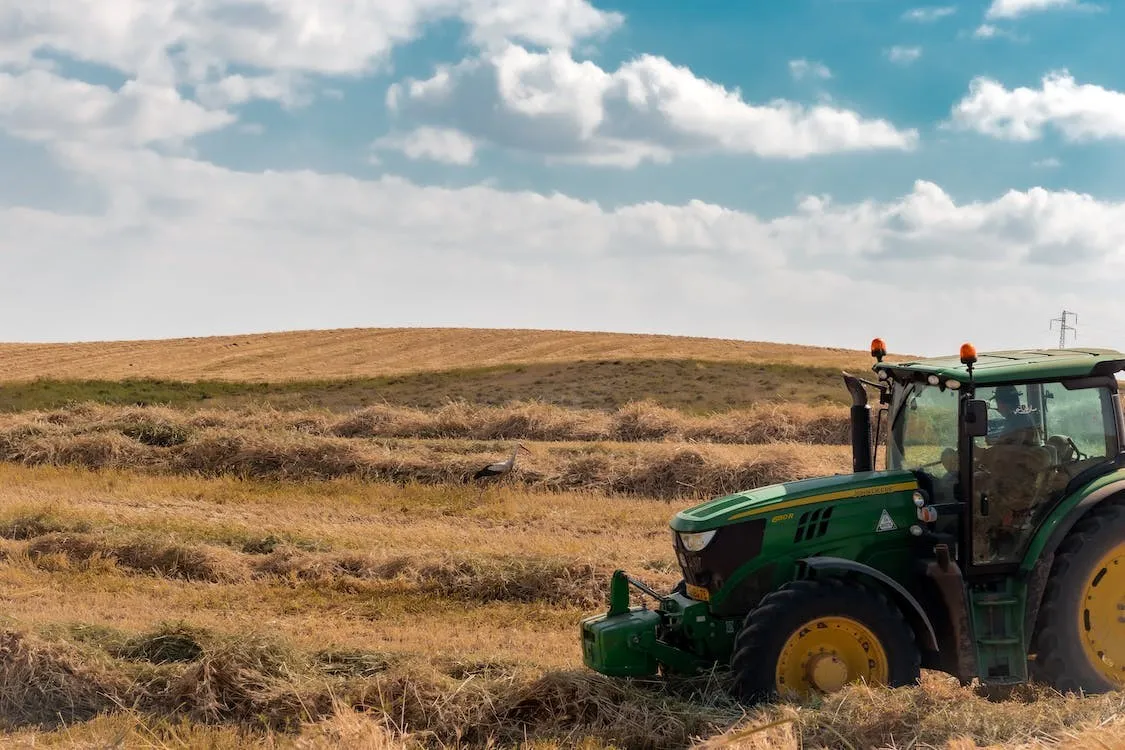
Compulsory category T driving licence for tractors
In principle, a category T driving licence is always needed if an LBT (agricultural or forestry tractor) or an MMBS (motor vehicle with limited speed) is used on public roads. Examples of an MMBS are a forklift truck, a mobile shop vehicle (SRV-wagen), a sweeper vehicle (bezemwagen) or a road train. If one of these vehicles is only used on private land, a category T driving licence is not needed. There are a number of other exceptions in which a category T driving licence is not needed, even if the vehicle is used on public roads.
Only compulsory on public roads
The category T driving licence is only compulsory if one of these vehicles is used on public roads. This means all roads open to public traffic. Bridges and culverts, for example, also fall under this. The same applies to pavements, footpaths, cycle paths, parking spaces, car parks and pedestrian areas. In other words, it covers all roads on which people can freely walk or drive, without this being explicitly prohibited by the owner. An example of an explicit prohibition is a gate or access control. If a road is temporarily closed because of roadworks, the closed part is also public.
Exceptions to the compulsory category T driving licence for tractors
There is an exception for vehicles that are no wider than 130 cm (including the interchangeable equipment at the front) and that are used for weed control, sweeping, clearing snow, gritting against slippery roads, collecting dog waste or mowing. The vehicle may not (be able to) pull interchangeable machinery or a trailer. The driver then does not need to hold a category T driving licence.
There is also an exception for forklift trucks with a width of 130 cm or less. Here too, towing machinery or trailers is prohibited. Bear in mind that the compulsory training for forklift truck drivers under the Dutch working conditions legislation (Arbowetgeving) still applies.
Difference between the tractor certificate and the category T driving licence
The tractor certificate (trekkerscertificaat) is a proficiency certificate and is not an official driving licence. It was a requirement imposed in the past by the working conditions legislation on certain groups of people who use a tractor for work. The category T driving licence, on the other hand, is a Dutch driving licence that you need to be allowed to drive on public roads. With the introduction of the category T driving licence, the tractor certificate lapsed. Holders of the tractor certificate could exchange it for the category T driving licence for a certain period. This period has now expired.
Improving road safety
With the introduction of the category T driving licence, the government wanted to improve road safety. A great many accidents happened with agricultural vehicles and tractors. And that while more and more agricultural vehicles are being used on public roads year after year. With the introduction of the category T driving licence, the aim is to improve driving skills and reduce the number of accidents. In almost all other European countries, a category T driving licence was already compulsory. Moreover, it was the last category of motor vehicles without a driving licence requirement. These factors also played a part in the introduction of the compulsory category T driving licence for tractors.
Getting the category T driving licence step by step
Since 1 July 2015, you have been required to hold a category T driving licence if a tractor or an MMBS is used on public roads. The theory exam can be taken from the age of 15.5. The practical exam can be taken from the age of 16.
- Study the theory
Taking theory lessons is not compulsory, but it is advisable. Various organisations offer theory lessons. You can also study the theory yourself. Theory books are available for this. It is advisable not only to study the theory, but also to take practice exams. The practice sets are often the best preparation for the theory exam.
- Take the theory exam
From the age of 15.5, it is possible to take the theory exam. This exam tests whether the candidate has sufficient command of the traffic theory for tractors. Taking the theory exam costs about €40.
- Take practical lessons
Taking practical lessons is not compulsory, but it is advisable. You can do this through a driving school or through a school for agricultural education. How many practical lessons are needed is something to decide together with the driving instructor.
- Take the practical exam
The practical exam shows that you have sufficient command of traffic practice for tractors. The practical exam is taken with an examiner and tests how you handle a number of traffic situations in practice. The practical exam costs about €230.
- Apply for the category T driving licence
After passing the practical exam, you can apply for the category T driving licence. To do so, you must fill in a health declaration (Eigen Verklaring). With it, you declare that you are physically and mentally fit to drive a vehicle. The municipality will charge application costs. The amount can differ from one municipality to another.
Other rules for tractor drivers
The driver of a tractor must not only hold a valid category T driving licence, but must of course also observe the traffic rules. Among other things, this means that the rules on driving under the influence of alcohol and drugs also apply. If the category T driving licence was issued as a first driving licence, it counts as a novice driver's licence with a blood alcohol limit of no more than 0.2 per mille. And if the licence is confiscated by the police, it is also no longer permitted to drive another motor vehicle (for example a car). You must also have valid liability insurance or tractor insurance.
Read also: Tractor registration plate.
Frequently asked questions about the tractor driving licence
With the introduction of the tractor driving licence, the driving licence requirement now applies to a last category of motor vehicles. The introduction of the tractor driving licence has caused some confusion. Many people still have questions about the tractor driving licence. Below, a number of frequently asked questions about the category T driving licence are answered.
From what age can I start lessons for the category T driving licence?
From the age of sixteen, it is possible to start practical lessons. This is also the age at which you are allowed to take the driving test for the category T driving licence. In general, young people need more lessons. The driving instructor will help determine the number of lessons needed.
Can I drive a tractor with a category B driving licence?
If you have a category B driving licence issued before 1 July 2015, you are allowed to drive a tractor for the period of validity of the licence. Category T will be added automatically when the category B driving licence is renewed. However, when the licence is renewed after 2025, the T entitlement will lapse. Anyone who obtained the category B driving licence on or after 1 July 2015 may not drive a tractor on the basis of it.
Do I need a category T driving licence if I use a tractor on my own field?
No, a category T driving licence is only compulsory if the tractor is used on public roads. If you drive the tractor on public roads to get to your land, you do need a category T driving licence. If you do not go onto public roads, you do not need a category T driving licence.
Is the certificate of professional competence still valid?
No, with the introduction of the category T driving licence, the tractor licence for young people (trekkerrijbewijs jeugdigen) and the certificate of professional competence (certificaat van vakbekwaamheid) have lapsed. Instead, you must hold the category T driving licence.
What working conditions rules apply to working with tractors?
The Dutch working conditions legislation (Arbowetgeving) works with goal-oriented requirements that should make safe and healthy working possible. Among other things, this means that the employer must identify and assess the risks. He must also inform his employees about these risks, instruct them and protect them. The working conditions catalogue for the agricultural and green sectors (Arbocatalogus Agrarische en Groene Sectoren) sets out how this should be done.
Do I need to get a category T driving licence if I have a category C driving licence?
No, anyone who has the category C driving licence automatically also has the category T driving licence. When the category C driving licence is renewed, category T will simply be added.